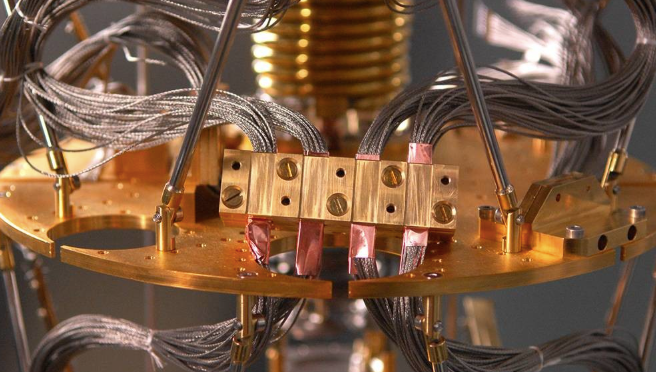
Quantum computers leverage the unique properties of quantum mechanics to process information. They utilize qubits, which can represent multiple states simultaneously through superposition. This fundamental characteristic allows for the execution of complex calculations at unprecedented speeds. Quantum gates manipulate the states of these qubits, forming the basis of quantum circuits. However, the intricate nature of quantum entanglement introduces both potential advantages and significant challenges in practical applications. Understanding these elements is crucial for exploring the future of quantum technology.
The Basics of Qubits and Quantum States
At the core of quantum computing lies the qubit, a fundamental unit of information that distinguishes quantum systems from classical counterparts.
Unlike classical bits, which exist in a binary state of 0 or 1, qubits exploit quantum superposition, allowing them to represent multiple states simultaneously.
This property enables quantum computers to perform complex calculations exponentially faster than traditional systems, unlocking new possibilities for computation and problem-solving.
Quantum Gates and Circuits
Quantum gates serve as the fundamental building blocks of quantum circuits, enabling the manipulation of qubits to perform quantum computations.
Various quantum gate types, such as Pauli, Hadamard, and CNOT gates, are employed in circuit design to achieve specific transformations.
These gates facilitate complex operations, allowing for the construction of quantum algorithms that leverage superposition and entanglement, ultimately enhancing computational power and efficiency.
See also: How IoT Is Transforming Smart Homes
Quantum Entanglement and Its Applications
How does entanglement fundamentally alter the landscape of quantum information science?
Entangled particles exhibit correlations that defy classical intuitions, enabling instantaneous state determination across distances. This phenomenon underpins quantum communication protocols like superdense coding and quantum key distribution.
Measurement effects on one particle instantaneously influence its entangled counterpart, facilitating advanced computational models and secure data transmission, ultimately redefining the capabilities of quantum computing.
Challenges and Future of Quantum Computing
While the potential of quantum computing is substantial, several significant challenges must be addressed to realize its full capabilities.
Quantum error correction remains a critical hurdle, as inaccuracies can disrupt computations.
Additionally, scalability issues pose obstacles in expanding quantum systems to handle larger problems efficiently.
Overcoming these challenges is essential for harnessing the transformative power of quantum technologies in various applications.
Conclusion
In summary, quantum computing represents a paradigm shift in information processing, leveraging the unique properties of qubits, quantum gates, and entanglement. As researchers navigate challenges akin to decoding an ancient script, the potential applications of quantum computers in fields such as cryptography and optimization continue to expand. The future of this technology holds promise, yet its realization will require overcoming significant technical hurdles to unlock unprecedented computational capabilities.